







How organisations are managing the AI skills deficit - AI Skills and Adoption report
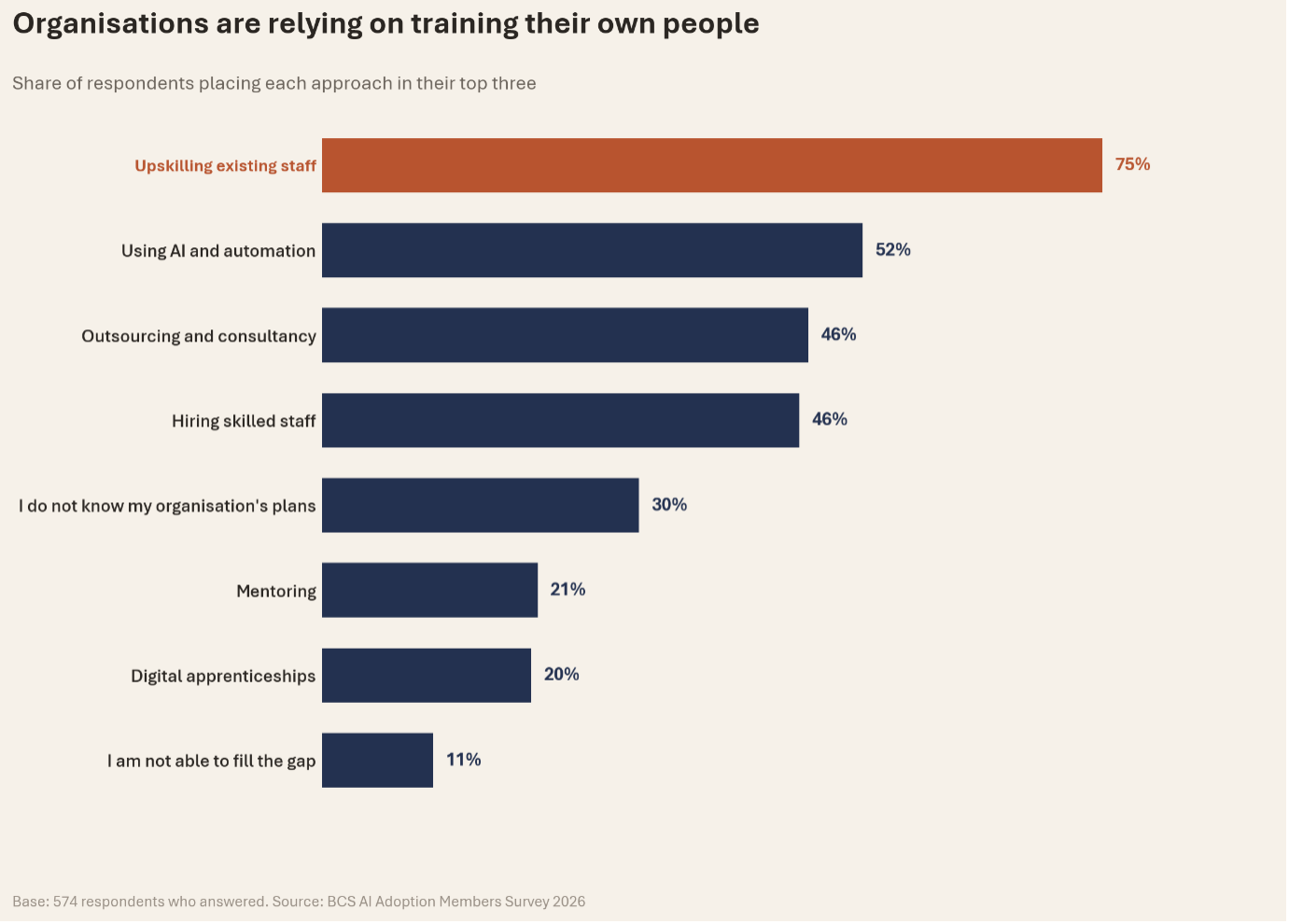
Our research set out to understand how organisations are managing the growing risks of this AI skills deficit. Their first answer is to train their own people: upskilling existing staff is comfortably the most common plan, placed in the top three by 75% of those who answered, ahead of using AI and automation (52%), outsourcing and consultancy (47%) and hiring skilled staff (46%). The emphasis on upskilling and AI and automation as ways to close gaps both echo last year's research, though the two years are not directly comparable and the comparison is one of direction onl. Two further figures stand out: 30% of tech professionals do not know their organisation's plans to close its skills gaps at all, and 11% say the gaps simply cannot be filled.
For those who feel that their organisations cannot fill the gaps, the reasons are mainly financial, and much of that may be beyond any organisation's control. But two threads are worth drawing out from the qualitative research. The first is uncompetitive pay, an issue raised repeatedly and pointedly from respondents with knowledge of the public sector, where the NHS, the Civil Service and local government were all described as unable to attract or hold the people they need. The second is a failure to treat the issue as a priority at the top, with respondents pointing to a lack of recognition and ownership from senior leadership rather than a lack of awareness lower down. Even where money is the binding constraint, its effects fall hardest on the least resourced: as one respondent at an SEND school put it, ‘As a SEND school with very little budget we just have to do what we can on the fly.’
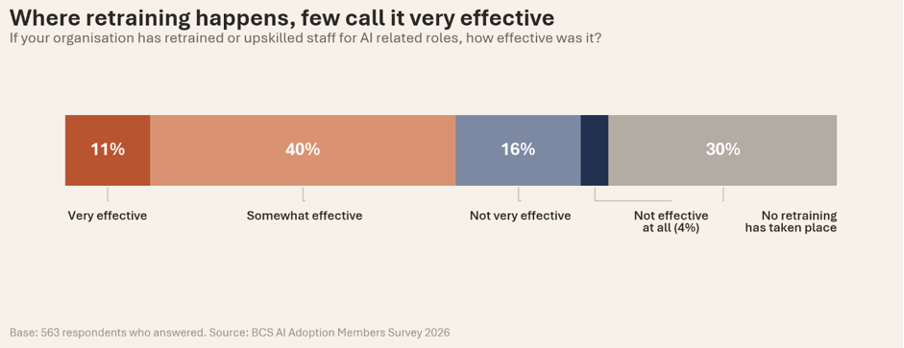
Where organisations do retrain their staff, it is often not landing. Only 11% of tech professionals rate their organisation's AI retraining ‘very effective’, around half consider it effective to some degree, and nearly 30% say no retraining has taken place at all. The question leans towards more specialist, AI-related roles, so these figures speak to that end of the workforce in particular. Their explanations, though, are revealing, and they point well beyond just effectiveness. Many feel that it is too early to judge, with adoption still in its infancy. But a more troubling pattern recurs. In a great many organisations there is no real training at all: people are left to teach themselves.
People have mostly been left to learn themselves as they go along’, one respondent wrote, in a comment that stands in for dozens like it. And where training does exist, it is frequently too shallow, focused on operating a particular tool rather than on judgement or strategy.
‘AI Training simply has been how to use MS Copilot’, as one respondent summed their experience up, capturing a widely shared frustration that staff are taught which buttons to press but not how, when or whether to trust what the tool produces. Compounding all of this, according to respondents, is a pace of change that dates course material almost as soon as it is written.
The picture, then, is of a response that is real but uneven, and often too thin: strong intent to upskill is undercut by tight budgets, uncompetitive public sector pay, patchy leadership ownership, and training that too often teaches tools rather than judgement. The AI skills deficit is not being closed at the pace, or the depth, that the technology demands. That gap between effort and effect is precisely why so many tech professionals are now calling for something more structured and more accountable, and it is to that call that we turn next.