







The AI Skills gap - AI Skills and Adoption report
Asked to rank the most important technology skills gaps in their organisations, tech professionals put AI top by a decisive margin. AI was the most common single choice, ranked the biggest gap by 35% of respondents, and 70% placed it in their top three, well ahead of cyber security in second.
Because the question asked about gaps across the organisations they work in, and not only within specialist digital teams, this result points to a shortfall felt across the wider workforce. It is also not a new finding: AI was the top skills gap in our research last year too. For the second year running, the people closest to the technology are telling us that AI is the capability their organisations lack the most.
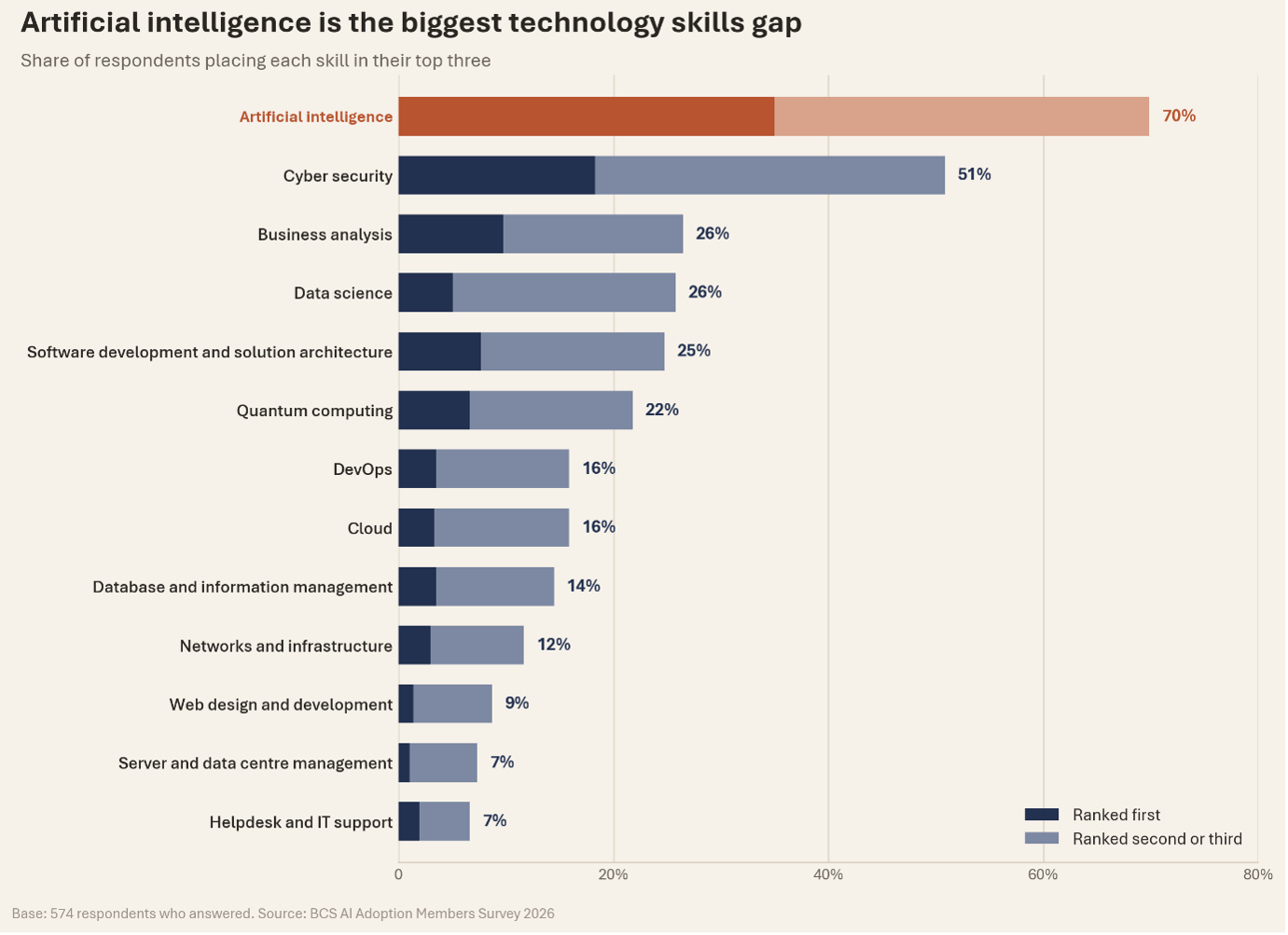
Success on improving AI skills depends on two tracks at once: a relatively small cohort of specialists who build and deploy AI, and the far larger, non-specialist workforce who need to use it well. Since the release of ChatGPT at the end of 2022, Government has recognised that developing both cohorts is a policy priority.
The AI Opportunities Action Plan and the Government’s response to it set an ambition to train tens of thousands of new AI specialists by 2030, while the AI Skills Boost programme aims to give 10 million workers, close to a third of the workforce, foundational AI skills by the same date, with free training now open to every UK adult.
More than a million training courses have been completed since the AI Skills Boost programme launched in mid-2025. On the specialist track, the number of students starting dedicated AI undergraduate degrees rose by 42% in the past year. But the absolute numbers remain small: that intake is just 1,165 students, just 4% of all computing first-years. When it comes to the rest of us, government research finds only 21% of UK employees feel confident using AI at work, and around one in six businesses were using AI tools by mid-2025.
What kind of AI skills are wanted matters as much as how many people need to have them. Asked which specific skills their organisations need, tech professionals described a spectrum that maps onto those same two tracks. At the specialist end, and the largest single group, were the skills to build AI systems; agentic development was the most frequently named skill of all. For the wider workforce, foundational AI literacy, enabling staff to use AI confidently in everyday work, alongside a strong thread of critical judgement, the ability to question and verify what AI produces rather than take it on trust, were the most desirable skills. Between the two sat a cluster that organisations appear to underestimate.
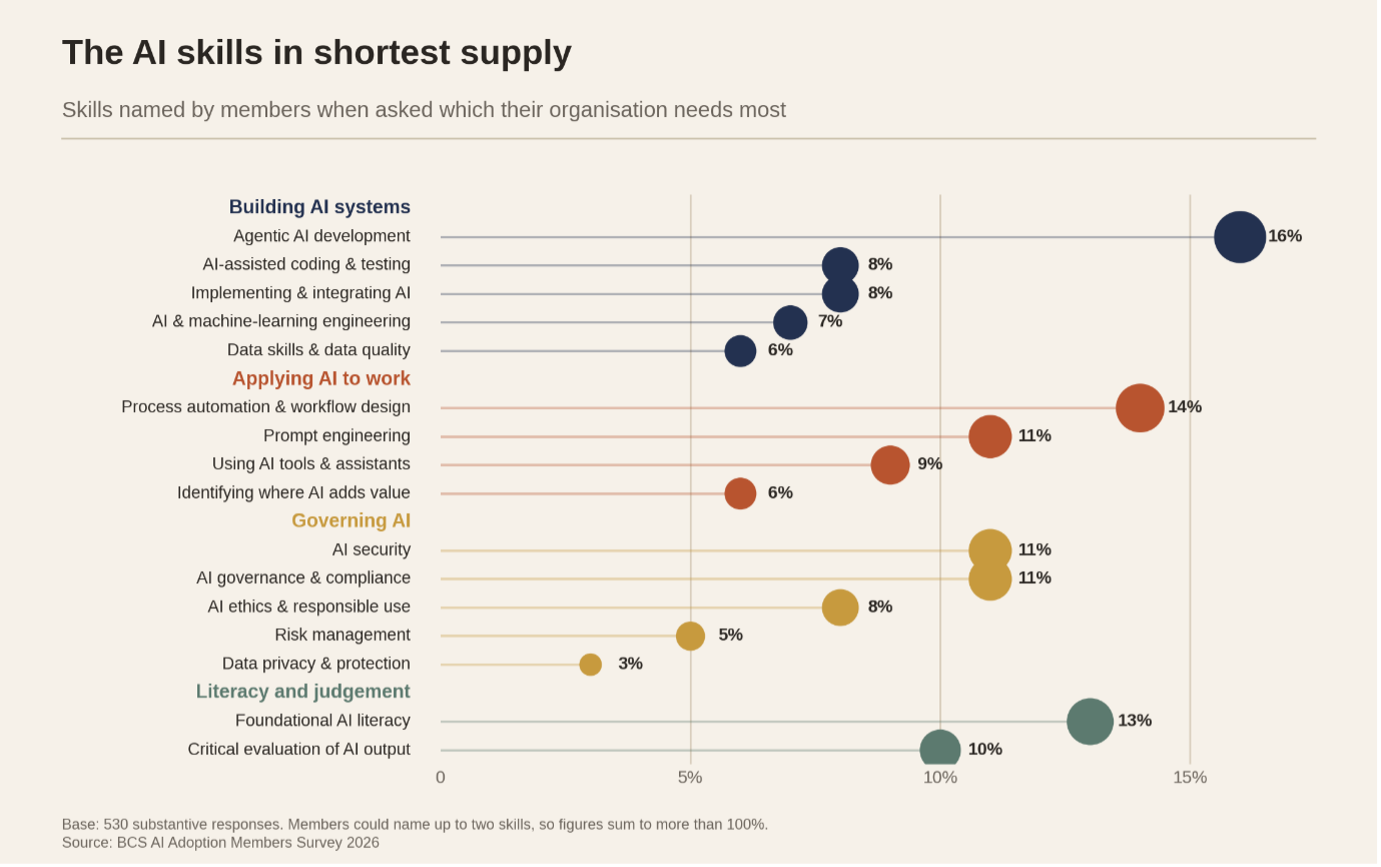
The ability to automate processes and redesign workflows around AI was the second most cited skill of all, named more often than prompt engineering or foundational literacy. Closely related, though named less often, was the ability to judge where AI actually adds value in the first place. Both are leadership responsibilities more than operational ones, and members reported a shortage of both. The quantitative findings point the same way: more than a quarter of respondents named a lack of clear use cases as one of the main challenges to AI adoption. Prompt engineering also featured as a skill shortage in its own right, a signal that organisations are not yet getting full value from the large language model tools they may already have ready access to.
Government was right to make AI skills a priority, and much of its policy is still being rolled out. But the evidence points to a considerable delivery gap: supply is improving, yet demand is outpacing it, and a shortfall first identified a year ago has not closed. This is not only a training challenge. When organisations adopt AI faster than they build the skills to use it well, the gap becomes a source of risk — to the quality of their decisions, to their operations, and to their costs. It is those risks, and the guardrails that are meant to contain them, that we turn to next.