







Gender and IT employment
4.1 Occupation
Further analysis of the gender balance for specific IT roles shows female representation within the IT professions varying from around one in twenty IT Engineers (6% over the 2020-24 period) - to around three in ten of those working as IT Project/Programme Managers, Web Designers/ Developers or IT Operations Technicians (34%, 34% and 30% respectively).
Representation was also very low amongst Telecoms Engineers, amongst which less than one in ten (9%) were women.
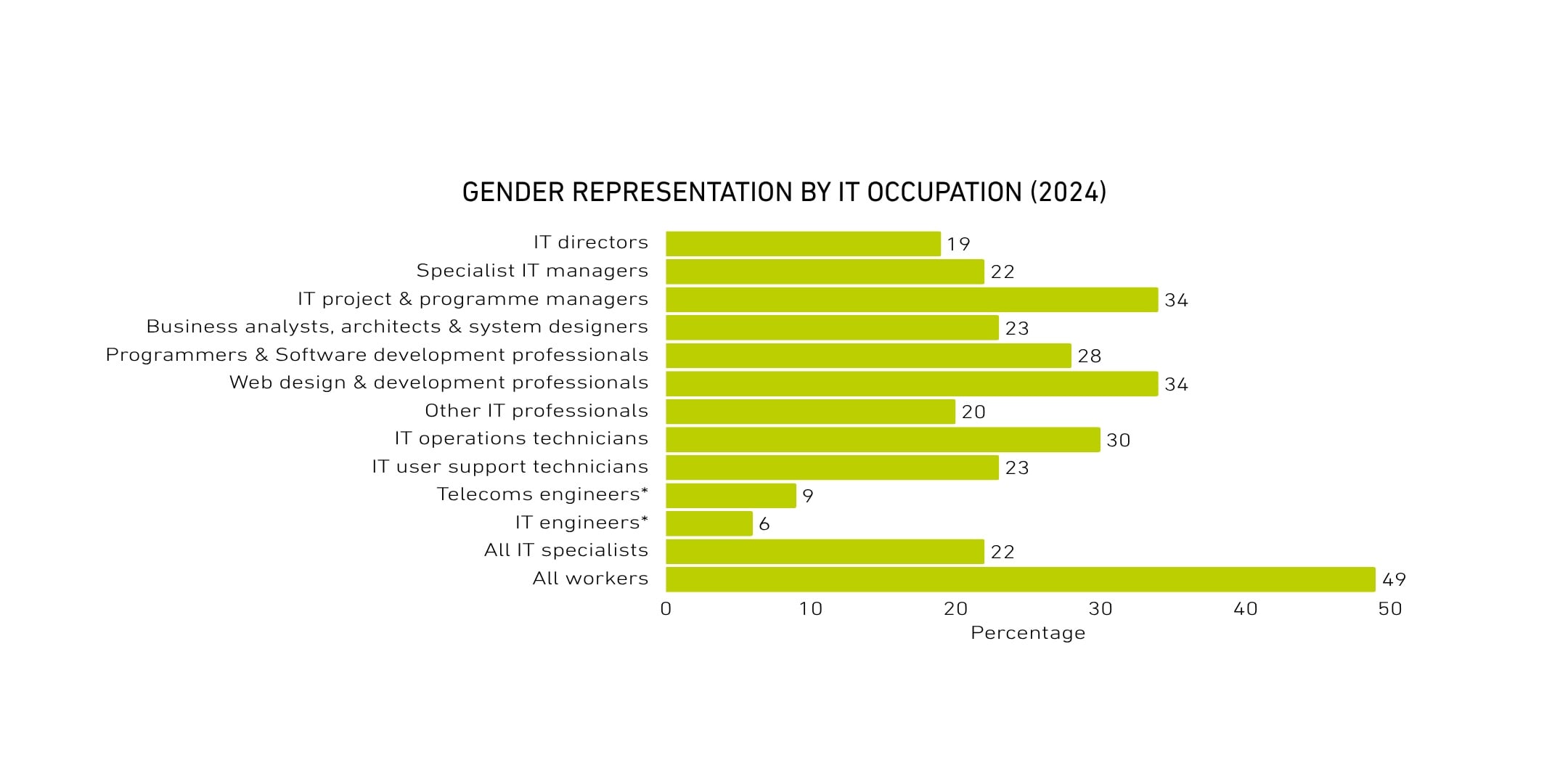
Source: Analysis of ONS Quarterly Labour Force Survey by BCS
* Five-year average.
4.2 Permanency of employment
Female IT specialists were marginally more likely to be working on a non-permanent basis as their male counterparts in 2024 (3% vs 2%) though in both cases the proportion working in temporary positions was lower than within the workforce as a whole (with comparison figures of 5% for both males and females).
While a detailed analysis of why IT specialists—both male and female—were in non-permanent roles during 2024 is not possible due to data limitations, respondents were asked whether their temporary employment was by choice. The findings suggest similar patterns: 27% of female IT specialists reported being in temporary positions because they did not want a permanent job, compared with 26% of their male counterparts over the 2020–2024 period.
4.3 Gender and unemployment
There were approximately 11,000 female IT specialists in the UK that were unemployed in 2024 i.e. 25% of all unemployed IT specialists in the UK during this period.
At 2.4% the associated unemployment rate for female IT specialists was notably higher that for males normally working in the IT field (1.9%) but still well below the overall unemployment rate for women in the UK (4.2%).
Employment characteristics
5.1 Self-employment
In 2024, there were approximately 131,000 self-employed IT specialists in the UK, representing 7% of the total at that time. The incidence of self-employment amongst female IT specialists however was slightly lower (5%) and well below the level recorded by women in the workforce as a whole (9%).
Source: Analysis of ONS Quarterly Labour Force Survey by BCS
5.2 Industry of employment
Overall, almost half (46%) of all IT specialists in the UK in 2024 could be found working in the IT sector though for women the figure was much lower at around three in ten (29%).
After IT, the next largest employer of IT specialists (male or female) was Banking/Finance (30% of female IT specialists and 25% of IT specialists as a whole), and the Public sector (23% and 15% respectively).
Looking in more detail at the levels of representation for female IT specialists in different industries in 2024, it can be seen that representation was highest in Public/Other Services with figures of 34% and 33% respectively.
Conversely, the manufacturing sector had the worst gender balance with regards IT specialists – where just 11% of IT specialists were women.
Source: Analysis of ONS Quarterly Labour Force Survey by BCS