







Skills
7.1 Qualifications held
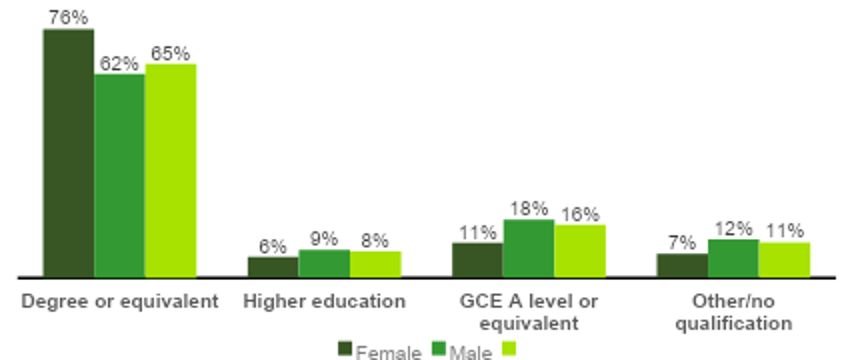
Female IT specialists appeared to be more highly qualified than males in 2024 with more than eight in ten (82%) holding a degree or other HE level qualification compared with around seven in ten males (71%).
This matches the situation within the workforce as a whole where 55% of women and just 49% of men were found to have qualifications at this level.
Level of educational attainment amongst IT Specialists (2024)
Source: Analysis of ONS Quarterly Labour Force Survey by BCS
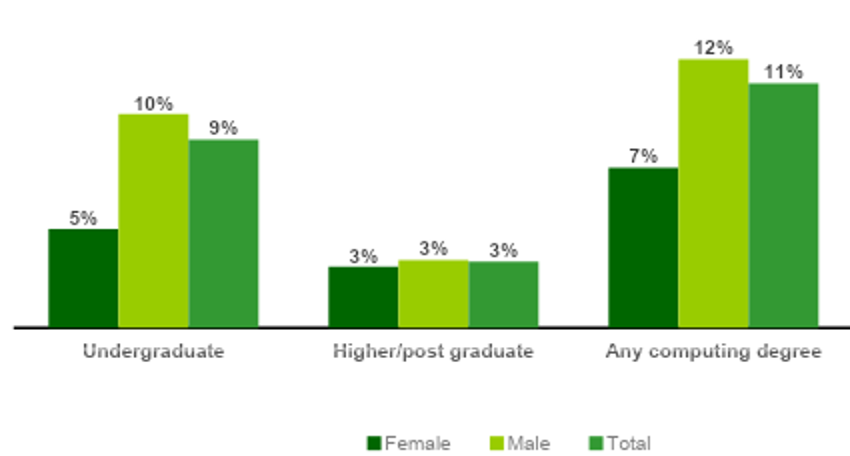
Though more likely to have a degree level qualification, female IT specialists are much less likely than males to have a degree in an IT related discipline – just 7% of female IT specialists stating that they held a qualification of this nature in 2024 compared with 12% for males working in IT roles.
IT specialists holding computing degrees (2024)
Source: Analysis of ONS Quarterly Labour Force Survey by BCS
7.2 Skills development
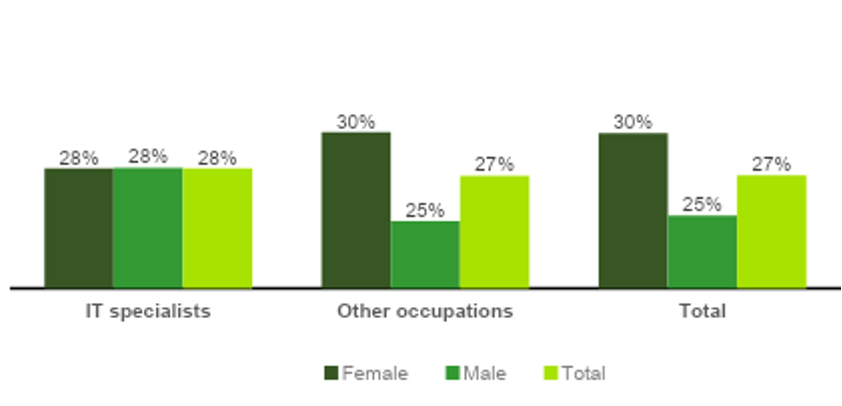
Female IT specialists were equally likely to receive job-related education/ training as their male counterparts during 2024 (28% in each case stating that they had received education/training during the previous 13 weeks when surveyed).
By comparison, amongst workers as a whole, women were more likely to have received education/training - 30% of women compared with 25% of men.
Job-related education/training in the past 13 weeks (2024)
Source: Analysis of ONS Quarterly Labour Force Survey by BCS
7.3 Skills sourcing
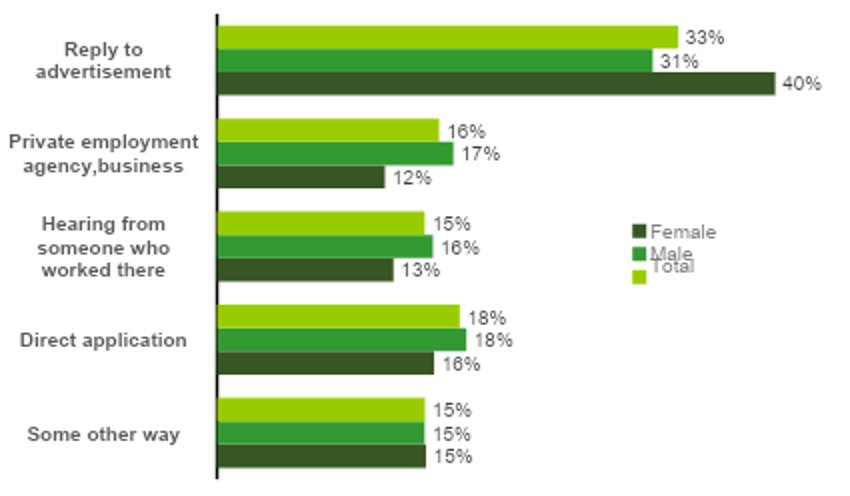
As with other UK employees, the most common identifiable means of IT specialists securing a job (where stated) during the 2020-23 period was by ‘replying to an advertisement’ (33% of those that had been with their employer for less than one year stating they had secured work in this manner), and this was true for both female and male IT specialists.
This said, the proportion of female IT specialists finding work in this way was much greater than for males (40% and 31% respectively stating this to have been the case).
The next most common means of IT specialists securing a job was through a direct application (18%) followed by private employment agencies (16%) and people already working at the prospective employer (15%). Of these, for private employment agencies in particular, it is notable that the likelihood of female IT specialists obtaining work this way was much lower than for males.
Means of finding work amongst IT specialists (2019-2024)
Source: Analysis of ONS Quarterly Labour Force Survey by BCS